
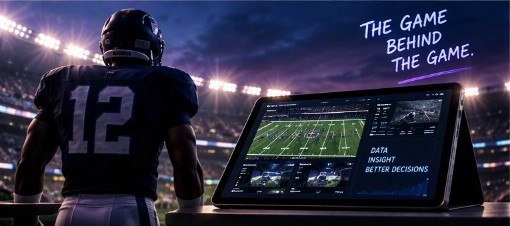
Most of us watch sports for the human part.
Someone hits the shot.
Makes the tackle.
Throws the pass.
Runs a ridiculous time.
A coach makes a decision everybody either loves or spends the next three days complaining about.
That’s the game we see.
Behind it, though, there’s another game happening.
And that one involves an incredible amount of technology.
Sports have become a data problem
Coaches have always looked for information.
Film study isn’t new. Statistics aren’t new. Scouting definitely isn’t new.
What’s changed is how much information can be collected and how quickly somebody can actually do something with it.
Modern teams can work with video, player tracking, performance information and other streams of data that would have been difficult to imagine not that long ago.
The interesting part isn’t simply collecting all that information.
It’s finding the useful piece before it matters.
That’s exactly the kind of problem software and artificial intelligence are good at.
Even the sideline is changing
A great example is the NFL.
Microsoft and the NFL have expanded their technology partnership around AI and sideline tools. Microsoft’s coverage of the partnership explains how Copilot can work with the NFL’s Sideline Viewing System to help coaches and players filter and analyze game information in real time — see their announcement.
Think about that for a second.
Football already has coaches, analysts and players trying to process an absurd amount of information while the game keeps moving.
Technology isn’t there to throw the pass.
It’s there to help a human find the useful information faster.
Honestly, that’s one of my favorite examples of AI because it isn’t particularly science-fiction sounding.
It’s practical.
The value is speed.
Then there are the athletes themselves
Wearable technology has added another layer.
Depending on the sport and system, sensors can collect information related to movement, workload and physiology. Researchers are studying how AI and machine learning can help turn that kind of data into useful information for training, performance and injury-risk decisions.
We’re basically getting better at measuring what the body is doing instead of relying entirely on what we think it’s doing.
That doesn’t mean an algorithm suddenly knows an athlete better than a coach, trainer or the athlete themselves.
Data still needs context.
But if technology can spot a pattern a human might miss, that’s pretty interesting.
Scouting gets weird too
Scouting has always been part numbers, part observation and part gut feeling.
Now imagine adding enormous amounts of searchable video and performance data to that process.
Software can help people look for patterns across more information than a human could realistically sit down and review manually.
I don’t think that makes the scout obsolete.
If anything, it changes the question.
Instead of spending all your time finding the information, you can spend more time deciding what the information means.
That distinction shows up constantly when we talk about AI.
What happens when everybody has the technology?
Here’s the part I find really interesting.
Technology creates an advantage when one team has something the others don’t.
But eventually everybody catches up.
Then the advantage moves.
Having data isn’t enough.
Having AI isn’t enough.
Having sensors isn’t enough.
You still have to know what to do with the information.
That’s true in sports and it’s true in business.
Give the same piece of software to two organizations and you can get completely different results because the software was never the whole equation.
People still matter.
Process still matters.
Judgment definitely matters.
The game is still human
I’m not particularly interested in watching computers play sports against each other.
We already have video games for that.
What makes sports interesting is that people are unpredictable.
Someone has the best game of their life.
Someone makes a terrible decision.
Momentum changes.
Pressure matters.
Emotion matters.
All the data in the world doesn’t completely remove that.
And I hope it never does.
But behind all of that humanity, there’s now an increasingly sophisticated technology layer trying to understand what’s happening.
Sensors.
Software.
Video analysis.
Data models.
AI.
The game hasn’t stopped being human.
There’s just another game running underneath it.
And if you’re a technology nerd who also likes sports, that may be almost as interesting as what’s happening on the field.