
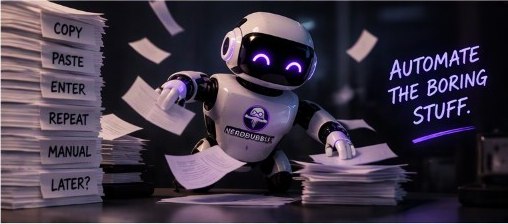
Let me clarify the title before somebody decides I’ve declared war on work.
I’m not saying you should stop doing your job.
I’m saying if you perform the exact same digital task every day, in the exact same order, using the exact same information, it’s probably worth asking why you’re still the one doing it.
Computers are extremely good at repetition.
Humans?
We get bored, distracted and irritated.
Usually in that order.
Look at what happens every morning
Think about the first hour of a normal workday.
Does somebody download a report?
Move numbers into a spreadsheet?
Check another system?
Send the same basic email?
Take information that came through a form and enter it somewhere else?
Maybe none of those things individually take very long.
That’s why they survive.
A five-minute task doesn’t feel like an automation problem.
It’s just five minutes.
But five minutes every day is different.
Then give three employees their own five-minute tasks.
Add a weekly 30-minute process.
Then that weird thing accounting has to do every Friday.
Suddenly a company is spending a surprising amount of human time moving information around.
Copy and paste is sometimes a warning sign
I use copy and paste constantly. I’m not suggesting Ctrl+C is evidence of organizational failure.
But repetitive copy-and-paste workflows are worth looking at.
If somebody takes the same type of information from System A and puts it into System B every day, that’s interesting.
Why can’t A talk to B?
Maybe there’s a good reason.
Maybe there isn’t.
That’s where APIs, integrations and custom software become useful.
And you don’t necessarily need to replace either system.
Sometimes you just need a bridge.
Automate the boring part, not the human part
I think automation gets a bad reputation because people immediately hear “replace employees.”
That’s not where I’d start.
I’d start with the stuff employees hate doing anyway.
Don’t automate the relationship with the customer if the relationship matters.
Automate the process that forces your employee to open four screens before they can help the customer.
Don’t remove judgment where judgment matters.
Remove unnecessary steps before the decision gets to the person making it.
That’s a much better use of technology.
The spreadsheet isn’t always the enemy either
Businesses love spreadsheets.
And honestly, I do too.
They’re flexible, everybody basically understands them and somebody can build a surprisingly powerful system without asking IT for permission.
The trouble starts when a spreadsheet quietly turns into infrastructure.
Everyone depends on it.
One person knows how it works.
There are six copies.
Three are named FINAL.
One is named FINAL-FINAL.
And nobody is completely sure which one Karen updated yesterday.
At that point, the spreadsheet may be telling you the business needs something more permanent.
Not necessarily a giant enterprise platform.
Just something designed for what you’re actually doing.
Start small
If you want to experiment with automation, don’t start by trying to automate your entire company.
Find one annoying process.
Something predictable.
Something repetitive.
Something where the rules are fairly clear.
Fix that.
See what happens.
You’ll learn more from automating one real process than you will from sitting through twenty presentations about digital transformation.
Then find another one.
Technology should remove friction
That’s really what I think good automation is about.
Not replacing everything.
Not adding technology because technology is cool.
Not giving employees one more dashboard to remember.
Just removing friction.
If information already exists somewhere, maybe nobody should have to type it again.
If something happens automatically every Tuesday, maybe nobody should have to remember Tuesday.
If a customer action should trigger three internal steps every single time, maybe software should take care of the first two.
The goal isn’t to automate everything.
The goal is to stop wasting people on work a computer can do perfectly well.
So tomorrow, pay attention.
If you catch yourself doing something you’ve done exactly the same way a hundred times before, stop for a second and ask:
Why am I still doing this?
That question might save you a lot more than five minutes.