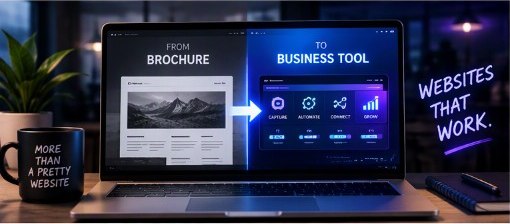
I still see a lot of websites that basically work like brochures.
Here’s who we are.
Here’s what we do.
Here’s a picture of the building.
Here’s our phone number.
Thanks for stopping by.
And look, sometimes that’s enough. Not every business needs some giant web application with 40 integrations and an AI chatbot asking everybody how it can help.
But if your website is important to your business and all it does is explain that the business exists, you may be leaving quite a bit on the table.
A website can actually do work
This is the shift I think businesses sometimes miss.
A website does not have to be a marketing piece sitting on the internet.
It can be part of the operation.
A customer fills out a form.
Where does that information go?
Does somebody receive an email and then type it into another system?
Or can the website send the information where it actually belongs?
Someone asks for a quote.
Can the website collect enough information to get that process moving?
A customer needs something simple at 10:30 at night.
Can they get it without waiting until somebody answers the phone tomorrow morning?
That’s when a website starts becoming much more interesting.
Forms shouldn’t be dead ends
Forms are probably one of the easiest examples.
Lots of business websites have them.
Name.
Email.
Phone.
Message.
Submit.
Then what?
In way too many cases, the answer is: somebody gets an email.
That’s fine if all you need is an email.
But imagine the person is requesting service. The information could potentially create a lead, notify the correct employee, start a workflow and give the customer confirmation without somebody manually pushing the information around.
The customer doesn’t care that five technical things happened behind the scenes.
They just think your company was easy to work with.
That’s the whole point.
Your customers already expect this
People have gotten used to doing things online.
They can track packages, schedule appointments, check bank accounts, order food and manage practically every other part of their lives without making a phone call.
Then they reach a business website where the only option is:
Call us Monday through Friday, 8 to 5.
Sometimes that’s necessary.
Sometimes it’s just the way the site was built ten years ago.
Those aren’t the same thing.
Pretty still matters
Now, none of this means design doesn’t matter.
It absolutely does.
If your website looks sketchy, confusing or like it hasn’t been updated since everybody was using Internet Explorer, people notice.
But I think good design and good functionality should work together.
The site should look good.
It should make sense.
It should be fast.
It should work well on a phone.
And whenever possible, it should actually help the visitor accomplish whatever they came there to accomplish.
A beautiful website that frustrates customers isn’t a good website.
It’s just a pretty problem.
Connect the website to the business
This is probably the biggest opportunity.
Your website doesn’t have to exist off on its own little island.
It can talk to other systems.
It can start automations.
It can pass information into business software.
It can let customers interact with information that previously required an employee.
It can become a front door into the systems already running the company.
And this is where custom development gets interesting.
Instead of asking, “What cool thing can we put on the website?” ask:
“What can customers or employees do through the website that would make everybody’s life easier?”
That’s a completely different way to think about web development.
Build something useful
There will always be room for simple websites.
Sometimes you need a clean way to tell people who you are, what you do and how to reach you.
Nothing wrong with that.
But when you’re rebuilding a website anyway, it’s worth asking if it could do a little more.
Maybe a lot more.
Because your website isn’t paper.
It doesn’t have to sit there waiting for somebody to read it.
It can actually do something.
And personally, I think that’s when the web gets a whole lot more interesting.