
When most people hear “software development,” they probably picture somebody sitting in front of a computer writing code.
Which is fair.
That’s still a pretty big part of it.
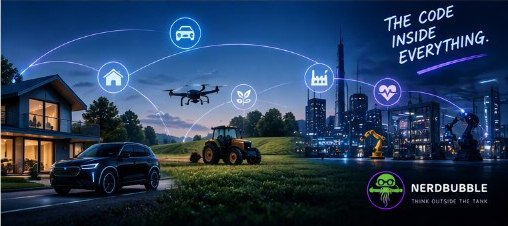
But the more interesting thing, at least to me, is what the code is connected to now.
Cars.
Houses.
Factories.
Farms.
Watches.
Cameras.
Heating systems.
Machines.
The physical world and the software world aren’t really separate anymore.
And that’s creating some pretty strange possibilities.
Your car is becoming a computer that moves
Cars may be one of the easiest examples.
For most of automotive history, if you wanted your vehicle to gain a new capability, somebody probably had to physically install something.
Now vehicles increasingly contain software-controlled features and connected systems that can be updated and changed electronically.
That’s a completely different idea of what a product is.
You can buy a physical object and have its behavior change later because the software changed.
Think about how weird that would sound if you explained it to someone 40 years ago.
“Yeah, tomorrow morning my car might be slightly different because it downloaded something.”
Okay.
Sure.
Houses are doing it too
The same thing is happening inside homes.
Lights can react to schedules or sensors.
Thermostats can adjust automatically.
Cameras can identify activity.
Doors can report their status.
Appliances can send notifications.
A bunch of those things are relatively simple by themselves.
But connect them together and suddenly the house starts behaving more like a system.
This happens.
So do that.
If nobody is home, change this.
If this sensor triggers, notify somebody.
We aren’t just controlling devices anymore.
We’re creating rules for physical spaces.
That’s basically programming.
Farms and factories may be even more interesting
When technology people talk about connected devices, they have a habit of showing a smart lightbulb.
That’s fine.
I like smart lights.
But industry is where this idea gets really interesting.
Sensors can monitor equipment and conditions.
Software can respond to information coming from machines.
Farm technology can use connected equipment, location data, sensors and automation to help manage real-world operations.
Now the output isn’t something happening on a screen.
Something changes in the physical world.
A machine adjusts.
Equipment moves.
A person gets alerted.
A process starts.
That’s a really different type of software from a website showing you a button.
Then AI gets involved
Connected devices create data.
Usually a lot of it.
And once there is enough data, the obvious next question is:
What the hell do we do with all of this?
That’s where AI becomes interesting again.
Not because everything needs AI.
It doesn’t.
Sometimes an if/then rule is perfectly fine.
But when the data becomes too complicated for simple rules, machine learning and AI can help identify patterns or make sense of information much faster than somebody manually staring at it.
Sensors give software eyes and ears.
AI potentially gives it another layer of interpretation.
That’s when things start feeling futuristic really fast.
Wearables bring the idea even closer
Now put sensors on us.
A watch can measure information about movement and other signals from the body.
Fitness devices can turn that information into trends.
Software can take something happening physically and represent it digitally where it can be tracked, compared and analyzed.
There’s a huge difference between that and a computer program that only knows what somebody typed into it.
The software is starting to observe the real world.
We are programming outcomes
I think that’s the bigger shift.
Software development used to feel like building things that lived inside computers.
Now we’re increasingly building systems where software can cause something to happen outside the computer.
A customer clicks something and a business process starts.
A sensor detects something and equipment responds.
A vehicle receives software and its behavior changes.
A wearable collects information from your body and software tries to make sense of it.
Code isn’t only telling pixels what to do anymore.
It’s influencing physical things.
That opens some big questions
Obviously, this comes with plenty of issues.
Security matters a whole lot more when software controls something physical.
Privacy matters when devices collect information about people and their environments.
Reliability matters when the consequence of bad software is bigger than a webpage looking weird.
The closer software gets to the real world, the more seriously we have to take the software.
But it also creates enormous opportunities.
And that’s why I think the future of development is bigger than “building apps.”
We’re building connections between digital information and physical reality.
We used to write software for computers.
Now we’re increasingly writing software for the world.
And we’re probably just getting started.